Year 9 OPTIONS
The year 9 option process helps the transition from Key Stage 3 (years 7-9) to Key Stage 4 (years 10- 11). Year 9 students are offered a range of subjects to choose from to study in year 10 and 11.
(I)GCSE Programme at KUWAIT ENGLISH SCHOOL
| (I)GCSE Programme at Kuwait English School |
The following are the criterias students need to follow when choosing their subjects:
|
Course Information
ACCOUNTING
Why study the Pearson Edexcel International GCSE in Accounting?
Universities and employers accept IGCSE Accounting as proof of an understanding of the theory and concepts of accounting, and the ways in which accounting is used in a variety of modern economic and business contexts. Students focus on the skills of recording, reporting, presenting and interpreting financial information; these form an ideal foundation for further study, and for a future career within many professions including accountancy.
Examinations
There is no core/extended curriculum option/route. The examination board is Pearson Edexcel and the qualification is IGCSE Accounting (4AC1) (9-1). Please see the information about (9-1) grading and its equivalence to A*-G grading on page 4 above.
| Paper 1 | 2 hours | A mixture of multiple-choice, short- and long-answer questions |
|---|---|---|
| Paper 2 | 1 hour 15 minutes | A structured written paper |
Your final mark/grade will be calculated according to the following weighting:
- Paper 1: 67%
- Paper 2: 33%
The Future
Today’s accountant is a key member of the management team for all private, public, nonprofit and governmental organisations. Accounting is “the language of business” since all business people use it to communicate. It provides excellent career opportunities and a strong foundation for upward career mobility. More CEOs have undergraduate or graduate degrees in accounting than any other area of study! Set your sights for the big-time. Accounting is a good foundation for those pupils thinking of a career in Accountancy, Banking & Finance, Management, Insurance, or for those who wish to run their own business. In fact, Accounting is an important skill in any work environment.
ARABIC - IGCSE AND GCSE
Course Description
Two Arabic examinations are offered, GCSE Arabic and IGCSE Arabic.
GCSE Arabic is for students for whom Arabic is a second language. This course will be taught instead of Ministry Arabic. This would be a useful choice for anyone who enjoys language and would be a useful addition to your job application later. Kuwaiti students may take this examination in addition to Ministry Arabic as it can count towards scholarships from the highest education.
IGCSE Arabic is for all students for whom Arabic is their first language. It is not compulsory for the students to take IGCSE Arabic, non Kuwaiti students may take Ministry Arabic instead. IGCSE Arabic is recognized as a subject in Egypt. What follows is a breakdown of the exam requirements of both subjects.
GCSE (9-1) in Arabic
- Pearson Edexcel Level 1/Level 2
- For this examination there are two levels. First level is the foundation tier and the second level is the higher tier.
- The students may do only one level which their teacher may choose for them.
All Kuwait English School students who will do the exam may do the higher tier not Foundation tier because of this reason: Higher tier the highest grade 9 which equals to A* but the foundation tier the highest grade is 5 which equals a C.
There are four exam papers, which you must take. Some of the questions on the papers will be in English and some in Arabic. You must answer in the language in which the question is written.
All four exams will be from these themes:
| Theme 1: Identity and culture |
|
| Theme 2: Local area, holiday and travel. |
|
| Theme 3: School |
|
| Theme 4: Future aspirations, study and work |
|
| Theme 5: International and global dimension |
|
PAPER 1: Listening Comprehension – Unit code: 1AA0 /1H (25%of the total GCSE) and the Total Mark is 50. Timing 45 Min.
Students are assessed on their understanding of standard spoken Arabic by one or more speakers in a range of public and social settings. Students will respond to multiple-response and short-answer open-response questions based on a recording featuring male and female Arabic speakers. Students must answer all questions in both sections. There is no requirement for students to produce written responses in Arabic.
- Section A is set in Arabic. The instructions to students are in Arabic.
- Section B is set in English. The instructions to students are in English.
PAPER 2: Speaking in Arabic – Unit code 1AA0/2H (25% of the total GCSE) Total number of marks is 70. Timing 10-12 min plus.
Students are assessed on their ability to communicate and interact effectively through Speaking in Arabic for different purposes and in different settings. There are three tasks, which must be conducted in the following order:
- Task 1 – a role play based on one topic that is allocated by Pearson.
- Task 2 – questions based on a picture stimulus based on one topic that is allocated by Pearson.
- Task 3 – conversation based on two themes. The first theme is based on the topic chosen by the student in advance of the assessment. The second theme is allocated by Pearson.
The assessments are conducted by teachers in one session within a prescribed assessment window, the recordings are then submitted to Pearson for external marking. The focus of speaking unit will be relate to the upper five themes:
PAPER 3: Reading Comprehension – Unit code 1AA0/3H. (25% of the total GCSE) Total number of marks is 50.Timing 1 Hour 5 Minutes.
Students are assessed on their understanding of written Arabic across a range of different types of texts, including advertisements, emails, letters, articles and literary texts. Students are required to respond to multiple-response and short-answer questions based on these texts. Students must answer all questions in each of the three sections:
- Section A is set in English. The instructions to students are in English.
- Section B is set in Arabic. The instructions to students are in Arabic.
- Section C includes a translation passage from Arabic into English with instructions in English.
PAPER 4: Writing – Unit code 1AA0/4H . (25% of the total marks) Total marks 60.
Timing 1 Hour 25 minutes.
Students are assessed on their ability to communicate effectively through writing in Arabic for different purposes and audiences. Students are required to produce responses of varying lengths and types to express ideas and opinions in Arabic. The instructions to students are in Arabic. Word counts are specified for each question. Students must answer all questions.
Higher tier – two open-response questions and one translation into Arabic. First one written between 80-90 words and the second one written between 130-150 words.
For all Papers students are not allowed a bilingual dictionary.
IGCSE Arabic
All candidates take Components 1 and 2 and are eligible for the award of grades A* to G.
Candidates will take:
- Component 1 – Reading – Weighting 50%
Duration of Examination 2 hours - Component 2 – Writing – Weighting 50%
Duration of Examination 2 hours
Description of Papers
The question papers will be set entirely in the target language. Dictionaries may not be used in the examination.
Paper 1: Reading (2 hours)
50%
It includes two texts. The student has to:
- Answer questions of the first text.
- The student has to summarise ideas and meanings of both texts approximately ( 200 – 250 ) words.
Paper 2: Writing (2 hours)
50%
Candidates will be required to write two compositions, one from each of the following two sections:
- Section 1 – Discussion and Argument. Four argumentative or discursive titles will be set, from which candidates will choose one.
- Section 2 – Description and Narration. Four titles will be set (two descriptive and two narrative), from which candidates will choose one.
Candidates will be required to write between 350 and 500 words for each of their answers. 25 marks will be available for each composition.
Ministry Arabic
All Kuwaiti students will follow the syllabus laid down by the Ministry of Education in Kuwait in Years 10 & 11.
This course includes poetry and literature, and the development of oral and written skills in grammar. Reading and composition work also make up a large part of the syllabus.
Requirements of The Subject
An examination at the end of year 11. The examination is taken at a centre nominated by the Ministry.
Note:
Non-Kuwaiti Arabian students can be supplied with resources for Ministry Arabic in Year 12, and arrangements made for the examination to take place at a centre nominated by the Ministry of Education. Please contact the Arabic department for further information.
ART AND DESIGN
Pearson Edexcel – IGCSE Art & Design (9-1)
An education in Art and Design is essential for anyone interested in a career in Architecture, Textiles and Fashion design, Jewellery, Furniture design, Interior design, Graphic design, Digital Art, CGI, as well as the Fine arts of Painting and sculpture. Art develops communication skills and self confidence, problem solving skills and teamwork. Anyone who has a grade C or above and likes Art can learn, through practice, to become good at it. You will be able to work in any way you wish, once you have learned about materials, processes and skills.
The Art & Design Department offers the following IGCSEs:
We recommend that pupils attain a certain percentage in their May examinations in Art & Design in order to study the syllabuses offered in Fine Art or Textile Design at IGCSE. It is proposed that a pupil who attains a C grade or approximately 55% may opt to study Fine Art or Textile Design.
In year 10 in Fine Art and Textile design the student’s will have mini projects that will help the students to cover all the processes and techniques needed to be successful at IGCSE.
In year 11 students will be able to choose what theme/ project they want to pursue. Year 11 deadline for coursework to be completed with final piece 30th January. Year 11 deadline for examination work and final piece is around 10th May. ( These dates can be adjusted by the teacher and exam).
IGCSE Fine Art
This course is designed to develop your creative thinking. You will develop drawing, painting, printing and collage skills and be introduced to mixed media and some sculpture as well as digital Art and photography using Adobe software. Projects will allow you to explore the work of others and experiment with different media and processes. All projects give you a set amount of time to develop and then produce a Fine Art outcome.
IGCSE Textile Design
This course covers many of the school’s skills taught in Fine Art and more such as, block printing, image transfer, weaving, screen printing, silk painting, fabric stencilling, fabric dying, using sewing machines, recycled fashion, appliqué and assemblage. You will produce coursework exploring the work of other artists and experiment with the above techniques and processes leading to a final textile based piece of work that can take the form of constructive textiles, furnishing, furniture design, interior design, fashion design and accessories.
An IGCSE in the above will help you learn to develop confidence and become innovative, independent thinkers. The skills that you develop will allow you to pursue work in:
- Observational drawing. Drawing in different media and styles.
- Painting and related media. Painting, drawing, printmaking.
- Three dimensional studies. Sculpture and Ceramics.
- Textile Design. Constructed textile and fashion.
- Digital photography.
In year 11 you will be given a major project, which will form 50% of your final course work assessment, with the other 50% coming from the exam.
BIOLOGY
Course Description
The Biology Course in Years 10 and 11 is a continuation and extension of the work from Years 7 – 9, with additional topics for IGCSE. This course is designed to develop skills in both theory and practical work, and is an enjoyable and stimulating subject. It is an excellent foundation for those students who intend to pursue a career requiring knowledge of biology. It is also a course with content applicable to life after school, for those not wishing to pursue a biology based career.
Some of the areas studied are:
- Characteristics and classification of living organisms (5% of teaching time).
- Organisation and maintenance of the organism (50% of teaching time)
- Development of the organism and the continuity of life (25% of teaching time).
- Relationship of organisms with one another and their environment (20% of teaching time).
Assessment
There are three assessed areas of knowledge in Biology, which are:
- Knowledge with Understanding (50%)
- Handling Information & Solving Problems (30%)
- Experimental Skills and Investigations (20%)
Examination
We study using the Cambridge International Exam Board – syllabus 0610.
The final grade is determined by three examinations:
Core
Paper | Question Type | Time and Marks | Weighting (%) | Level of Entry | Grades Available |
|---|---|---|---|---|---|
1 | Multiple choice | 45 mins and 40 marks | 30 | Core only | C-G |
3 | Short-answer and Structured Questions | 75 mins and 80 marks | 50 | Core only | C-G |
Extended
Paper | Question Type | Time and Marks | Weighting (%) | Level of Entry | Grades Available |
|---|---|---|---|---|---|
2 | Multiple choice | 45 mins and 40 marks | 30 | Extended only | A*-G |
4 | Short-answer and Structured Questions | 75 mins and 80 marks | 50 | Extended only | A*-G |
Core and Extended
Paper | Question Type | Time and Marks | Weighting (%) | Level of Entry | Grades Available |
|---|---|---|---|---|---|
6 | Alternative to practical | 60 mins and 40 marks | 20 | Core and extended | C-G or A*-G |
Students are entered at one of two levels: Core or Extended. If students are entered at Core they sit 3 papers (1,3 & 6) and can obtain Grades C to G. If students are entered at Extended level, they sit 3 papers (2,4 & 6) and can obtain grades A* – G.
The Future
Biology is essential for any career in medicine or veterinary work, pharmacology, dentistry, ophthalmology, agricultural science, biochemistry, drug development, molecular biology, genetic engineering, marine biology, food technology, chiropody, environmental health.
BUSINESS STUDIES
Why study the Cambridge International GCSE in Business?
IGCSE Business Studies looks at the business environment, the structure of organisations and aspects of marketing, production and finance. The role of people in business is studied, with attention paid to recruitment and training, and motivation and communication of the individual at work.
While it is obvious that those planning on working in most industries and prospective entrepreneurs should study business, all people should learn as much about business operations as possible. This includes those in the scientific, medical, education and government sectors, along with those who are simply consumers of products and services.
Becoming knowledgeable about how businesses operate helps everyone understand how the engine that drives the world’s economies works.
Fact: Business Administration and Management is the most popular degree in the United States.
Examinations
There is no core/extended curriculum option/route. The examination board is Cambridge IGCSE Business Studies (0450) and the grading system is is A*-G.
| Paper 1 | 1 hour 30 minutes | A paper containing short-answer questions and structured/data response questions. |
|---|---|---|
| Paper 2 | 1 hour 30 minutes | Candidates will be presented with a business situation or problem, and required to answer questions arising from it. |
Your final mark/grade will be calculated according to the following weighting:
- Paper 1: 50%
- Paper 2: 50%
The Future
A qualification in Business Studies is a good foundation for pupils thinking of a career in Management, Accountancy, Banking, Finance or Insurance. However having a sound knowledge in running a business will help in a career in any field.
CHEMISTRY
Course Description
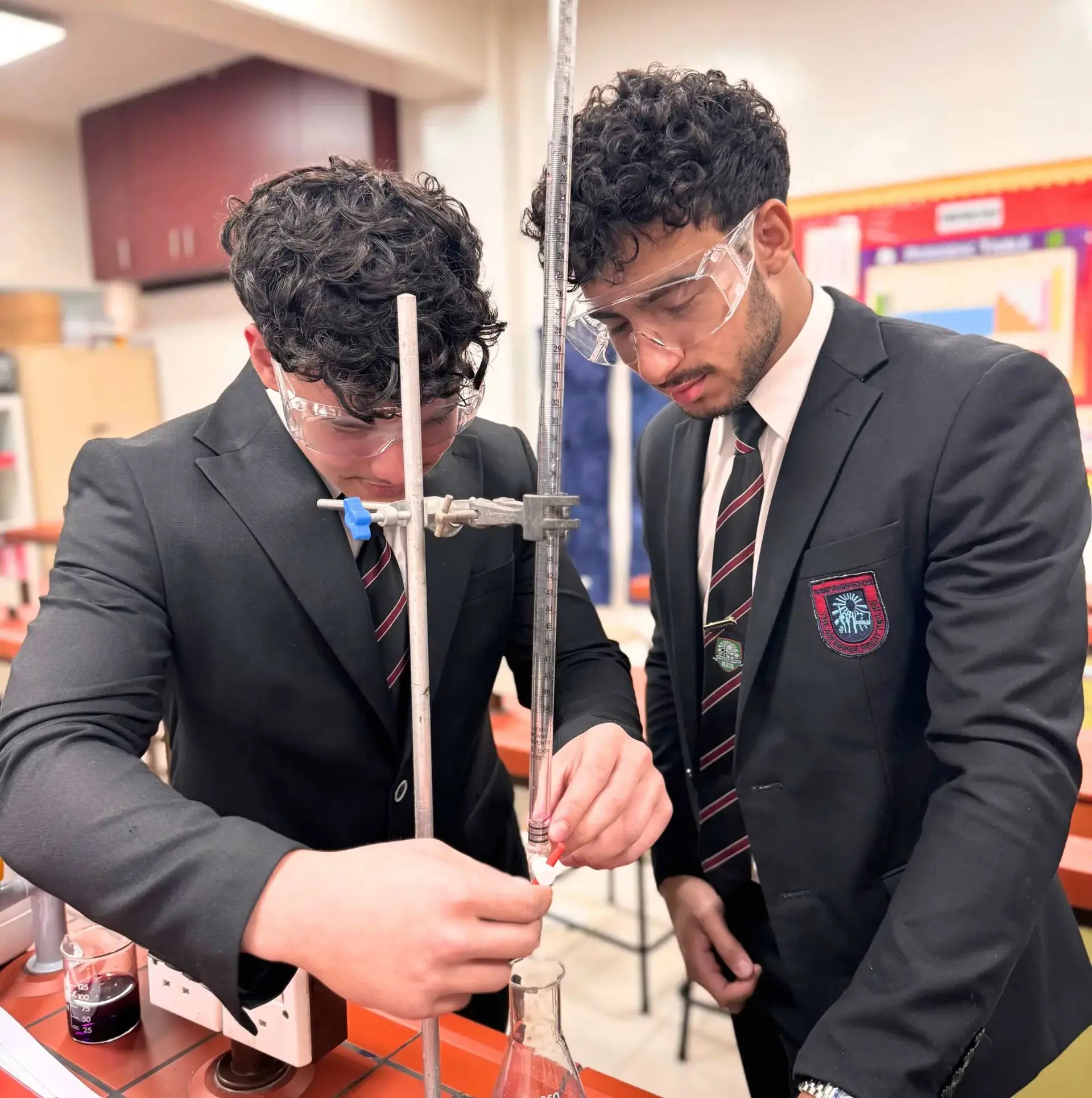
The curriculum to be covered at IGCSE Chemistry includes the following: Atomic Structure, Bonding and the Structure of Matter, Stoichiometry, Electricity and Chemistry, Chemical Energetics, Rates of Reaction, Reversible Reactions, Redox, Analysis of Gases and ions, Metals, Organic Chemistry, Quantitative Chemistry, Sulphur, Air & Water, Carbonates.
Assessment
All candidates will follow the extended curriculum at IGCSE and will be eligible for the award of Grades A*-G. This means that they will be entered for examination papers 2, 4 and 6. However, if after two years of study, we believe the student is capable of only a Grade C, then they will be entered for Papers 1, 3 & 6 only. The papers are as follows:
- Paper 1: (45 minutes) (30%) Core Curriculum: Multiple Choice Paper. 40 Questions.
- Paper 2: (45 minutes) (30%) Extended Curriculum: Multiple Choice Paper. 40 Questions.
- Paper 3: (1 hour 15 mins) (50%) Core Curriculum: Compulsory short answer and structured questions, designed to discriminate between Grades C-G.
- Paper 4: (1 hour 15 mins) (50%) Extended Curriculum: Compulsory structured and free response questions designed to discriminate between Grades A* to B. This paper will mainly target the Higher Grade questions.
- Paper 6: (1 hour) (20%) Alternative to Practical: This is a written paper with compulsory questions designed to test familiarity with practical laboratory procedures. Candidates will not require knowledge outside the Core Curriculum.
If a student is entered for the Extended Papers, these will allow for an award of A*-G grade. If the core papers are taken then only C-G Grades may be awarded.
The Future
An IGCSE Chemistry qualification is essential for courses in medicine, dentistry, pharmacy, chemical engineering, environmental science, microbiology, biochemistry, genetics, forensic science, food technology, petrochemical and oil industry.
Exam Structure
| Paper 1 |
|
| Paper 2 |
|
| Paper 3 |
|
| Paper 4 |
|
| Paper 6 |
|
COMPUTER SCIENCE
Course Description
The IGCSE Computer Science course is an excellent introduction to the world of computing technology and the science that lies behind it. This really could be the start of a rewarding and challenging career that will put you at the forefront of the next major developments in technology. You will also learn skills and techniques that will improve your ability to think logically and problem solve.
This course is not an absolute requirement for a specialist university computing courses or computing careers, but success in it will give you firsthand experience of what it is like being an expert software engineer, games programmer or web designer.
Although there is a substantial practical element to the course, the theory component is both extensive and demanding. The mathematical content is also quite significant as you will be expected to carry out calculations in Base 2 and Base 16 as well as Base 10.
You are also expected to develop a logical approach to problem solving, along with an enquiring and innovative attitude towards breaking down a complex problem into manageable parts. You will also apply your knowledge to solve a real life problem.
All work for this course can be done without access to a computer at home, but regular practice of your technical skills outside of the classes is essential for progress in this subject.
Assessment
Paper 1: Computer Systems 1 hour 45 minutes (50%)
This written paper contains short-answer and structured questions. All questions are compulsory.
Paper 2: Algorithm, Programming and Logic 1 hour 45 minutes (50%)
This written paper contains short-answer, structured questions and a scenario based question. All questions are compulsory.
The Future
This highly specialised and technical field leads to a variety of different careers all at the forefront of technological development. Be part of the next big thing!
Examples of specialist computer careers would include:
- Software engineer
- Programmer
- Electronic engineer
- Network engineer
- Web developer
- Systems designer
- Games developer
- Hardware engineer
- Robotics
- Mechatronics
To study Computer Science at AS or Advanced GCE you need to have no formal qualification in the subject, but it is imperative that you have studied IGCSE Computer Science first. You will find that the AS/Advanced GCE course in Computer Science will build on much of the knowledge and skills you have already developed during IGCSE. The most important factor is that you have an interest in software and software systems and how they interact with computer hardware.
You will learn about:
- Computational thinking which is thinking about what can be computed and how, and includes consideration of the data required
- Understanding of the main principles of solving problems by using computers
- The skills necessary to solve computer-based problems using a high-level programming language
- Understanding of the component parts of computer systems and how they interrelate
- Understanding of the internet as a means of communication and its associated risks
- Understanding of the development and use of automated and emerging technologies
On completion of this course students will be well aware of what a future career as a Computer Scientist will entail.
AS Units
Paper 1: Theory Fundamentals – This written paper contains short-answer and structured questions. There is no choice of questions. Externally assessed 1 hour 30 minutes
Paper 2: Fundamental Problem-solving and Programming Skills – This written paper contains short-answer and structured questions. Candidates will also need to write answers in pseudocode. There is no choice of questions. Externally assessed 2 hours.
A2 Units
Paper 3: Advanced Theory – This written paper contains short-answer and structured questions. There is no choice of questions. Externally assessed 1 hour 30 minutes
Paper 4: Practical – This written paper contains short-answer and structured questions. There is no choice of questions. Candidates will also need to submit complete program code and evidence of testing. Externally assessed 2 hours 30 minutes.
The aims of the Cambridge International AS and AL Computer Science course, whether leading to an AS or A Level qualification are:
- To develop computational thinking
- To develop an understanding of the main principles of solving problems using computers
- To develop an understanding of the component parts of computer systems and how they interrelate, including software, data, hardware, communication and people
- To develop an an understanding of the different methods of communication and the functionality of networks and the internet
- To acquire the skills necessary to apply this understanding to develop computer-based solutions to problems.
What could I go on to do at the end of my course?
Computers and microprocessor based appliances are an essential feature of modern life, controlling daily activities in all aspects of society. This includes both commercial and domestic environments. As a technical expert you will be a key player in how these devices develop and shape our lives in the future. Robotics, artificial intelligence, bio-tech and mechatronics are just some of the exciting new developments in a rapidly developing technological field.
How to study?
Developing your knowledge of computational thinking, that is thinking about what can be computed and how by the use of abstraction and decomposition. It includes consideration of the data required. Learning computational thinking involves learning to program, by writing computer code, because this is the means by which computational thinking is expressed.
This is done by studying initially high and low level languages and using this knowledge to solve a variety of practical real life problems. In addition to this you will also be looking at how computers store and process different categories of data. How information is transported around networks is also another important area of study. In Year 13 all of these areas of study listed above are built upon further.
There are no practical examinations on the AS course and all assessments are externally marked. However, the AL course requires the student to complete a program code for an exam board issued problem using a high-level programming language and document evidence of testing. This will also be externally assessed.
Subject Combinations
A level Mathematics is a requirement for all Computer Science courses in higher education, and Physics is an essential preparation for some of the more hardware oriented courses, so you may want to consider these.
DESIGN TECHNOLOGY
Why study Design Technology?
- It will prepare you for life in our technological society.
- It will develop your creativity to improve the quality of life for yourself and others.
- It will help improve your knowledge and practical skills.
- It will make you a more discriminating user of products, which will help you evaluate the social, moral and environmental effects designers have on society.
- You will gain skills, which will be useful in a wide range of careers such as; product designer, engineer, architect, interior/exterior designer and practical skills that will benefit you for the rest of your life.
The problem-solving nature of Design Technology involves much more than simply the acquisition of practical skills. The design work undertaken will enable students to develop their creativity and flair whilst encouraging self-motivation, time management, and initiative which are essential given the demanding nature of the subject. These skills are necessary through all stages of personal and professional life and will help them prepare for the future.
Design & Technology at KES provides an exciting and creative environment, where students will be encouraged to discover many aspects of the design world. They will be required to combine their design and making skills with knowledge and understanding of materials, processes and design issues. Students will become involved in a process of design methodology in which they identify and solve practical problems in an imaginative yet logical manner. These solutions are presented through the creative use of a range of resistant materials.
Subject Content
- Designing
- Communicating Ideas
- Types of drawings
- CAD-CAM from CAD Software to using the CAM Machines
- Materials & components
- Processes & manufacture
- The wider world
COURSEWORK PROJECT (50% OF IGCSE)
You will need to produce an A3 portfolio based on a project theme of your choice.
This will involve 25-30 pages of A3 –
- Design brief
- Research & analysis
- Moral & social issues
- Specification
- Product development
- Presentation skills
- Communication techniques
- Ergonomics & anthropometrics
- Aesthetic considerations
- Product analysis
- Planning
- Material selection
- Manufacturing techniques
- Production methods
- Use of tools & machines
- CAD/CAM
- Environmental concerns
- Testing procedures
- Modification
- Material characteristics
- Quality control
- Economics & business
- Industrial practices
- Health awareness
- Working safely
- Evaluation
You will need to produce a three-dimensional outcome of your chosen product. This can be made out of modelling materials, wood, plastic or metal or a combination and included CAD-CAM using the laser cutter in the workshop.
Assessment
DT IGCSE comprises three sections.
Year 10
| Term 1 | Term 2 | Term 3 |
|---|---|---|
Coursework:
Core Knowledge: materials, processes, and techniques. Examination: Product Design (Paper 1) | Coursework:
Core Knowledge: materials processes and techniques Examination: Product Design (Paper 1) | Coursework:
Core Knowledge: materials, processes, and techniques. |
Year 11
| Term 1 | Term 2 | Term 3 |
|---|---|---|
Coursework:
Examination:
| Coursework:
Examination:
| Examination:
|
Year 11 final exam year expectations:
- Coursework Project (school-based, Terms 1 & 2, Year 11) – 50%
External Exam papers to sit:
- Paper 1 Product Design (1hr 15mins) – 25% of IGCSE
- Paper 3 Design (1hr) – 25% of IGCSE
Grades A* – G.
DRAMATC ARTS
Why study the Dramatic Arts?
In the 21st Century, the deployment of people in preference for computers has seen the rise of the Creative Class. Training in the Dramatic Arts is a unique preparation of students for today’s challenges and demands, mentally and physically. It is a perfect addition to Science and Humanities in holistic education, imparting critical life skills and the ability to develop and display leadership qualities and confidence.
Future Employment:
Qualifications in the Dramatic Arts have been accepted into the workforce in Team Leadership positions, the Police Force, Company Development and Design (media, film, event design) and the lucrative entertainment business (producers, managers, directors, actresses, stage managers, technicians, costume designers, choreographers).
The ability to bring a Concept to a Conclusion within a deadline through measured practical involvement, individually and in a team, is the fundamental requirement of all professions and is the basis of all Dramatic Arts programmes. Preparation, planning, teamwork, presentation, meeting challenges and evaluation are all skills honed within the projects of Dramatic Arts. Drama workshops are a part of company team-building programmes today due to their importance.
Personal Skills:
Participation in the Dramatic Arts creates cognitive assonance between thought, speech and action demanding expert communication, debating, questioning, researching, devising and presentation skills. Performance is a small part of the process, but a vital culmination of creativity and planning.
Projects involve social, cultural and historical understanding, the focus on thinking ‘out of the box’, the development of personal empowerment and the training to empower others. It is a very important development programme, practically incorporating and enhancing understanding of science, history, mathematics, budgeting and economics, design and languages.
Locations:
- All training will be conducted in the KES Drama Suite purposely built Black box/lecture theatre with projection screen, mirrored wall, lighting rig, camera, sound system and changing room
- A drama studio with a green screen, lighting rig, mirrors and sound system
The KES multipurpose stage with access to LED screens and full lighting rig and a sound system - Access to digital virtual theatre links with international theatres
- External off-campus locations for workshops with professional directors
Qualification:
Key Stage 4 IGCSE Drama
(which progresses to Key Stage 5 Drama and Theatre Studies AS and A2)
On completion of KS3 in year 9 students will have acquired the basic skills and terminology required for IGCSE. The development will create in-depth projects to display a multimedia message to audience members and examiners using dramatic elements and proxemics.
IGCSE Drama: Cambridge Syllabus 0411
Component 1: a written examination consisting of 3 sections (2.5 hours)
- The evaluation and description of practical application within two scripted plays
- The evaluation and description of practical application
Component 2: three practical filmed presentations
- An individual performance, a staged scripted monolgue from a play performed to an audience (3 – 5 minutes)
- A staged group performance of a play extract to an audience (20 minutes) A group devised performance performed to an audience (20 minutes)
Component 1: 40% Written Examination – 2 hours and 30 minutes.
Component 2: 60% Practical Examinations.
A prerequisite of this course is that the student takes IGCSE First Language English, due to the structure of the 40% written examination.
KES Drama and Theatre Arts alumni include:
- Shadi Alfons: a celebrated film/TV actor, scriptwriter, award ceremony commentator and was a major contributor to the creation of Saturday Night Live (Arabia). He is part of the celebrity duo ‘Shadi and Khalid’, Shadi has kindly agreed to be patron of theatre students of KES.
- Nadia Ahmed: Nadia Ahmed: a TV celebrity, documentary & filmaker and founder and director of LAPA International
ECONOMICS
Why study the Pearson Edexcel International GCSE in Economics?
This course will enable you to:
- Develop an understanding of economic concepts and apply these concepts to real-life situations
- Calculate, interpret and evaluate economic data in order to make reasoned arguments and informed judgements
- Develop an awareness of economic change and its impact on developing and developed economies
- Understand economic issues, problems and possible solutions that affect mixed economies
- Participate effectively in society as citizens, producers and consumers.
Course Description
Economics covers all areas of our daily life from shops and banks to government and trade. It is a lively, interesting subject, which involves a great deal of reading and hard work. The areas covered include:
- Markets
- Market Failure
- Economic Development
- Business and Finance
- Taxation and Government Spending
- Employment and unemployment
- Inflation
- International Trade
- Population
- Examinations
There is no core/extended curriculum option/route. All students sit Papers 1 and 2. The examination board is Pearson Edexcel Economics (4EC1) and the grading system is 9-1.
| Paper 1: Microeconomics and Business Economics |
|
| Paper 2: Macroeconomics and the Global Economy |
|
The Future
There are many economics and economics-related degree programs. As a professional economist with the skills and knowledge gained you could find yourself working in almost any field, for example, agriculture, medicine, education, law, energy, and environmental protection. Economics is also a good basis for careers in Management, Accountancy, Insurance, Banking and Government.
ENGLISH LANGUAGE AND LITERATURE
At IGCSE, there are a number of combinations of external examinations available. We offer English as a First Language, English as a Second Language and English Literature. It is possible for pupils to gain two or more IGCSEs in years 10 and 11.
We recommend that pupils attain a certain percentage in their summer examinations in English in order to study the different syllabuses offered in English at IGCSE. It is proposed that a pupil who attains a B grade or above (approximately 65%) will study English as a First Language with, or without, Literature. A pupil who attains less than 65% will be advised to study English as a Second Language. However, students below 65% attainment, if supported by their Year 9 English teacher and the Head of Department ( Ms Hallam), may be able to take the First Language curriculum if it is felt it is in their best interests to do so.
The rationale behind this is to effectively place your son/daughter in a class that enables us to maximize their achievement and fulfil the requirements of the next stage in their education. Historically, students and parents have had a wider choice on the course taken at IGCSE but we are no longer supporting high achieving students opting for English as a Second Language as we feel this does not serve their best interests long term within a global context.
Further, a student may study First Language English for two years and also sit the Second Language English IGCSE exam at the beginning of year 11 as an external exam, thus gaining two English credits for the IGCSE, but only on the proviso, they continue to study the First Language course until its completion (end of Year 11).
It is therefore important that your son/daughter achieve the very best grade they can in year 9.
In summary:
| IGCSE | Percentage Needed |
|---|---|
| English as a First language | 65% + (students who attain this score in Year 9 will NOT be allowed to opt for Second Language. We are an English school and therefore expect the majority of our students to take the First Language specification. |
| English as a Second Language | Less than 65% (students with less than 65% can opt for First Language only on recommendation from their English teacher and with final say from Head of English, Ms M Hallam |
| English Literature | On recommendation |
Please see further details of the courses offered on the following pages.
ENGLISH FIRST LANGUAGE
Course Description
This examination is primarily for those students whose first language is English or for those students whose proficiency in English is such that they are able to communicate fluently and accurately in English and attain 65% and above in the Year 9 examinations.
This examination is necessary if you are intending to go to an English speaking University. More and more universities globally are insisting overseas students obtain this qualification.
At Kuwait English School we follow the extended examination syllabus. The grades available are A* – G.
The aims of the course are to broaden the student’s understanding of language in many different forms and to ensure that they are able to communicate accurately, appropriately and effectively in speech and writing. Throughout the course, they will respond to a variety of written texts and develop an understanding of what they hear, read and experience.
It is hoped that by following this course students will enjoy and appreciate the English Language in all its forms and confidently develop an understanding of themselves and others.
Assessment
The examination consists of two papers.
Paper 1 (2 hours):
Reading (50%)
This examination tests the student’s ability to write in various forms, to analyse how writers achieve effects through their use of language and to collate and summarise points from a given passage.
Paper 2 (2 hours):
Writing (50%)
This paper tests the student’s ability to write in a variety of forms. It is necessary for them to be able to articulate experiences and order their ideas clearly as well as use appropriate grammatical structures.
The Future
There are numerous professions where this qualification is useful: journalism, public relations, law, teaching, publishing and script-writing. Think of it as a discipline that helps every other subject students study: English is the global language of medicine, science, engineering and business.
ENGLISH SECOND LANGUAGE
Course Description
The course is designed to develop the use of functional English for business and pleasure. The range of settings are those students are likely to encounter once they have left school. The topics studied will relate to: education, the world of work, current affairs, health and welfare, travel and school affairs.
The aims of the course are to enable students to use English effectively for the purpose of practical communication in a variety of second language situations. They will develop a sound base for the skills required for further study or employment using English as the medium. It is hoped that students develop their communication skills and are able to articulate their ideas with confidence.
Assessment
Our students follow the Extended Curriculum and are eligible for grades A* – G.
Paper 1 (2 hours):
Reading and Writing (70%)
This paper tests the student’s ability to extract relevant information and draw conclusions from, and see relations within, an extended piece of writing. They should be able to write fluently on a range of topics.
Paper 2 (45 minutes):
Listening (30%)
This paper assesses the student’s ability to understand English in a range of contexts and show an awareness of attitude or register based on what they have heard. Students should be able to make notes from material heard and identify important points discussed.
Paper 5: (15 minutes):
Oral
This paper takes approximately 15 minutes and is a test of the student’s ability to share their ideas in the form of a conversation. They will discuss a given topic with a teacher. The grades awarded for this paper are 1 (high) – 5 (low).
The Future
English is required for University entrance and in most professional fields of work. This examination is the very minimum you should study at KES.
ENGLISH LITERATURE
Course Description
This examination is designed for those students who have a genuine love of Literature. It is necessary that students wishing to follow this course have a proven record in English and have demonstrated a high level of proficiency throughout Years 7 – 9.
The aim of the course is, of course, to enjoy the study of Literature and to appreciate its contribution to aesthetic and imaginative growth. Throughout the course, we will explore areas of universal human concern, thus leading to a greater understanding of the individual and the world around us.
Students who are considering taking AS/A2 Literature in Years 12 and 13 are strongly recommended to follow this course.
Set Texts
At KES we follow the closed and open book examinations without coursework. You will study a range of literature in all of the three main literary forms: Prose, Drama and Poetry. You will develop an appreciation of texts, demonstrating knowledge and understanding and critical interpretation as discerning critics of literature. Students will typically study modern and contemporary literature, many of the texts are classical and of high regard within the literary canon. Students will also be encouraged to read widely.
Assessment
Your final assessment will consist of three papers.
Paper 1 (1 hours 30 minutes – 50%):
Prose and Poetry
Candidates answer two questions on two texts: one poetry and one prose. There is a choice of two questions (one passage-based and one essay) on each text.
Paper 3 (45 minutes – 25%):
Drama (Open Text)
Candidates answer one question on one text. There is a choice of two questions (one passage-based and one essay) on each text. Candidates must answer one passage-based question and one essay question.
Paper 4 (45 minutes – 25%):
Prose and Poetry (Unseen Texts)
Candidates answer one question. There is a choice of two questions requiring critical commentary (one based on literary prose and one based on a poem or extract of a poem).
It is important to note that Literature is taught alongside Language so does not impact on other option choices.
The Future
Used as an entrance qualification by some universities, it has been said that Literature qualifications are highly sought after and revered by universities.
Literature can lead to AS/A2 Level literature and a BA (Hons) degree. This can lead to a wide variety of openings. More importantly, the study of English Literature makes for a more rounded individual and leads to a deeper appreciation of Literature and the theatre.
Some pupils who have studied this subject in the past at KES have gone on to the very best universities in the UK, the USA, Europe and the rest of the world.
FRENCH
Following on from what students have learnt in previous years, the IGCSE French Course is designed to further develop the four skills of modern foreign language learning to an internationally recognized standard. This qualification would allow students to continue the subject at ‘AS/‘A’ Level or to take it up again at a later stage, perhaps at university, to suit their careers.
There are six main areas of study that cover a variety of activities. Topics include Local area, media, entertainment & youth culture, education, training & employment, health and fitness and social activities. The course will appeal to all types of students including those interested in travel, culture and people from different countries.
Assessment
Students taking the IGCSE examination in French are assessed in the four skill areas of study; listening, speaking, reading and writing. Students are entered for the summer exam where they will be able to gain access to Grades A*, A and B as well as the other grades.
There are four papers for the examination and they are equally weighted (25% each); Listening, Speaking, Reading and Continuous Writing. Besides developing their knowledge of the language they are studying, students will be able to develop key skills in Communication and Information and Communication Technology, whilst improving their own learning performance.
The Future
Our world is constantly shrinking and today there is a global market for jobs. Learning how to interact with speakers of other languages can help you see things from a range of perspectives, develop your problem-solving skills and make you more adaptable, resourceful and creative. Knowledge of a foreign language is not just another IGCSE grade, but is a concrete and demonstrable life skill, one which is highly valued by employers. It is not necessary to be completely fluent in a foreign language to be an asset to any potential employer, as knowing how to meet and greet people from other countries and cultures is a valued skill. Indeed the ability to operate cross-culturally is becoming just as valued by employers as straight language skills.
Many K.E.S. students already have their own mother tongue in addition to English and Arabic. Knowledge of a European language can only further enhance their chances of a successful and fulfilling career.
Examples of employment where language skills are particularly valued include:
Business and marketing, Engineering, Journalism and the media, Law, Civil service (Immigration, Customs, Diplomatic Service), Hotel industry, ICT, Sport and leisure, Travel and Tourism, Teaching
Important Facts
Anne Merritt is an EFL lecturer currently based in South Korea. She writes at http://annemerritt.com/
Learning a foreign language is more than just a boost to your CV or handy for travelling. It will make you smarter, more decisive and even better at English.
Physiological studies have found that speaking two or more languages is a great asset to the cognitive process. The brains of bilingual people operate differently than single language speakers, and these differences offer several mental benefits.
Below are seven cognitive advantages to learning a foreign language:
- Boosts brain power.
- Improves memory.
- Enhances the ability to multi-task.
- Sharpens the mind.
- Keeps the mind sharper for longer.
- Enhances decision-making.
- The first language is improved.
- Improves performance in other academic areas.
- More items…
Many of these attributes are only apparent in people who speak multiple languages regularly – if you haven’t spoken a foreign tongue since your A levels, our brain might not be reaping these bilingual benefits. However, people who begin language study in their adult lives can still achieve the same levels of fluency as a young learner, and still reap the same mental benefits, too.
You become smarter
Speaking a foreign language improves the functionality of your brain by challenging it to recognise, negotiate meaning, and communicate in different language systems. This skill boosts your ability to negotiate meaning in other problem-solving tasks as well.
GEOGRAPHY
Geography is a popular subject, which links scientific and economic theory to real-life situations. Geography bridges the divide between Arts and Sciences requiring a range of skills in order to analyse and understand different cultures. The course aims to be challenging, engaging and interesting for students with a broad interest in world affairs.
The Cambridge IGCSE course is broken down into the following themes:
- Population and Settlement: Population dynamics,Population structure, Population density and distribution. Migration, Settlements and Urbanisation.
- The Natural Environment: Earthquakes and volcanoes, Rivers and Coasts. Weather, Climate and Natural vegetation. The impacts of these environments on human activity.
- Economic Development: Development, Food production, Industry, Tourism and Energy. Water and Environmental risks.
Students investigate these topics and develop decision making skills. The course builds upon the topics studied in Years 7, 8 and 9.
Assessment
Assessment is by three examination papers at the end of the two-year course. All candidates follow the same curriculum and the examinations test their geographical knowledge, understanding, map work skills and fieldwork techniques.
Paper 1 – Geographical Themes
Paper 2 – Geographical Skills
Paper 4 – Alternative to Coursework
Students of Geography use a variety of learning strategies involving a wide range of texts, maps, field trips, ICT, individual, group work and discussion in order to support classroom learning.
The Future
The study of Geography is a subject that develops a wide range of skills, which may be adapted to a range of careers. Examples of careers directly related to the subject are as follows:
Journalism, Architecture, International Law, Oil and Gas Industries, Government, Water & Farm Management, Business Management, Environmental Engineering, Teaching, Leisure and Tourism, National Planning, Aviation, Urban and Rural Planning, Weather Reporting, Diplomacy, Environmental Management, Emergency Management, Climate Change Analyst, Hydrologist, Surveyor, Meteorologist.
HISTORY
History is an excellent option in many ways. You are taught firstly, about the past and why things happened and secondly and more importantly, your ability to argue and to prove your point is developed. Your language skills are expanded, and you are trained to write formal structured answers and to examine some of the more interesting and extreme aspects of history, for example Stalin’s murder of millions of his own people. The study of human behaviour and actions and the historical themes make the course interesting. You will be taught in a variety of methods including discussions, debates, chrome books, documentaries, texts, written work and role plays.
Assessment
The following topics are studied and examined as follows:
Paper 1 – International Relations 1919 – 1989. Depth study: Germany 1918 – 1945
- How the world struggled to come to terms with life after World War One.
- The collapse of order and the causes of World War Two.
- The division of the world into two sides in the Cold War and the collapse of communism.
- Includes case studies on the Korean War, Cuban missile crisis and the war in Vietnam.
- The development of the Weimar Government, the rise of the Nazis and life in Nazi Germany.
Paper 2 – This paper is a source paper based on a topic from Paper 1
Paper 4 – Paper 4 is based solely on the Depth study: Germany 1918 – 1945.
The Future
History is of importance in many careers and here are some of them: Teaching, Publishing, Law, Business Management, Politics and diplomacy, Archivist, Marketing, Archaeology, Administration, Banking, Civil Service, Public Relations, Writing and Journalism.
ICT
Over 77% of jobs now require information technology skills at a very high standard. The IGCSE ICT course is not only aimed to prepare you for the workplace, but also to help you discover which aspects of the subject you have an aptitude for. You will also learn skills and techniques, which will assist you in other subject areas.
This course is not a requirement for specialist university computing courses or computing careers, but success in it will help you work towards becoming an expert end-user of applications software, including word-processor, spreadsheet, database, presentation and website design software.
Although there is a substantial practical element to the course, the theory component is both extensive and demanding. You are also strongly encouraged to make yourself aware of new developments in information technology and its impact on society.
You are also expected to develop a logical approach to problem solving, along with an enquiring and innovative attitude towards applying information and communications technologies to solve practical problems in real-life contexts. It is essential to have access to a computer at home for regular practice of your ICT skills outside of the classes for success in this subject.
Assessment
- Paper 1 (1 ½ hours) Written paper – short-answer and structured questions with no choice (50%)
- Paper 2 (3 hours) Practical paper – taken under examination conditions (50%)
The Future
It will soon not be possible to find a job where computer literacy is not a requirement. Universities now expect all students to be familiar with many aspects of ICT. Examples of specialist computer careers would include:
- Systems Analyst
- Database Admin
- Programmer
- Network Manager
- Web Designer
- User Support
- IT Manager
- Software Engineer
- Web Developer
- Systems Designer
- Systems Manager
- Hardware Engineer
Other careers where computer skills have become essential:
- Management
- Scientific Research
- Marketing
- Military Work
- Law
- Medicine
- Accountancy
- Music Industry
- Telecommunications
- Publishing
- Architecture
- Business
A Level Studies
AS and Advanced Level GCE in ICT are no longer offered at KES. Students who wish to further develop their interest and knowledge in computing are advised to refer to the Computer Science course for further information about progression routes.
ISLAMIC STUDIES
All Arab Muslim students must study the Islamic syllabus as specified by the Ministry of Education in Kuwait.
- Islamic studies ( this includes noble hadeeth)
- Holy Quran.
REQUIREMENTS OF THE SUBJECT:
An examination at the end of Year 11. The examination is taken at a centre nominated by the Ministry.
MATHEMATICS
“Mathematics is the music of reason”- PAUL LOCKHART from “A Mathematician’s Lament”
“The essence of Mathematics is its freedom.” GEORGE CANTOR circa 1900
Mathematics is a stimulating and rewarding subject in itself, but also provides you with the tools to be able to understand many other disciplines. After all, without Mathematics you would not actually be able to complete courses in Engineering, Physics or Chemistry.
There are three levels of entry from Year 10 for Mathematics – HIGHER IGCSE, Accelerated HIGHER IGCSE and FOUNDATION IGCSE (all based upon the Edexcel International GCSE (9-1) Maths A course – code 4MA1).
Higher (possible grades 9-3 ). This is the course that most students will choose at KES. It is a challenging course that encourages the students to develop their analytical skills and reasoning ability. It builds on the work done during Years 7 to 9. Pupils wanting to continue Mathematics at AS (Advanced Supplementary) in Year 12 or A2 (Advanced) levels in Year 13 need to choose this course. This course starts in Year 10 and ends at the completion of Year 11.
Foundation (possible grades 5-1 ). This is a much easier course than Higher as it does not include many of the more complex topics. It reinforces much of the work covered in Years 7 to 9. This course is for students who struggle with Mathematics and who do not wish to take it at AS or A2 level. The course runs for two years, as with the higher option.
Higher and Foundation courses are externally assessed by two written papers at the end of Year 11, as detailed below.
| Higher (Edexcel IGCSE 9-3) |
|
| Foundation (Edexcel IGCSE 5-1) |
|
The department also offers an Accelerated Higher course of study, where the higher syllabus is covered in Year 10 ONLY instead of over two years. This means that the IGCSE examination is taken at the end of Year 10. Students who choose Accelerated Higher in Year 10 will , by signing up for it, accept that they must complete the International advanced Level (IAL) AS course in Year 11. Were they then stay for Year 12, the pupil would continue with the IAL A-Level course.
The department rationale behind offering the accelerated higher program is to facilitate the study of Further Mathematics in Year 13, which follows on from IAL A-Level.
Pupils need to be aware that the best UK universities consider Further Mathematics very favourably when offering places on numerate courses. Apart from Mathematics, of course, other such courses include all Engineering disciplines, Finance, Operational Research and, in particular, Computer Science.
Obviously, though taking AS in Year 11 has numerous benefits it is only recommended for the most able pupils in the school.
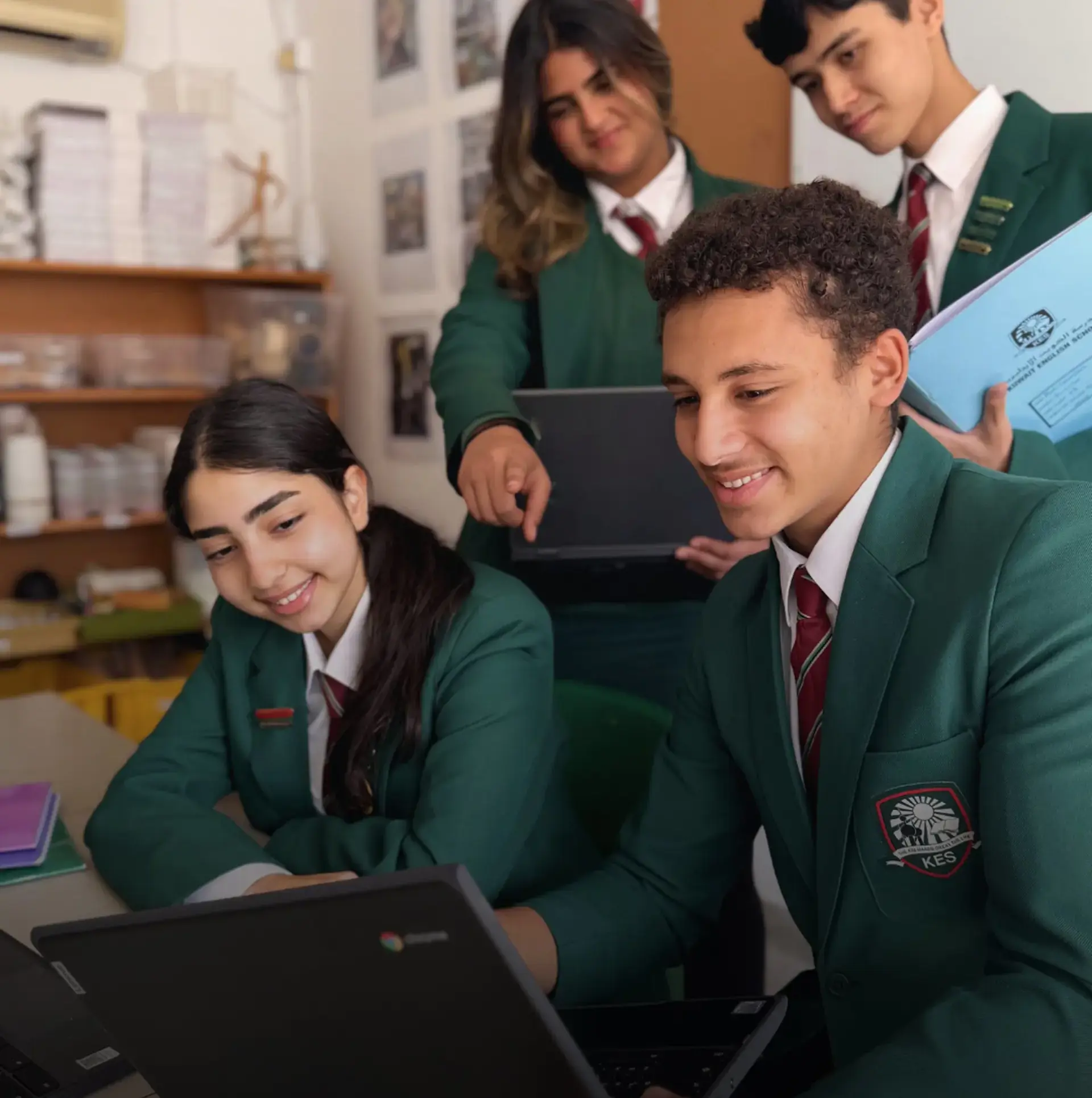
The integration of Chromebooks into the syllabus means that the mathematics department is able to embrace fully this new technology. All staff are aware that they are to use a mixture of teaching techniques as this is the only way to ensure that ALL students have a chance of progressing to the best of their ability.
The Future
Pupils who are good at this subject are in an extremely fortunate position. On leaving school with excellent AS or A2 (or Further Mathematics) qualifications, many opportunities await. University courses well suited to this subject include Architecture, Banking, Finance, Computer Science, all branches of Engineering (especially Mechanical and Civil), Mathematics, Natural Sciences, Physics, Economics, Accountancy, Stock broking, Actuarial Science and many more. In fact, students leaving university with a strong Mathematics degree will be widely sought after.
Employers will always be keen to recruit young trainees who have an affinity for decision making and who possess strong reasoning skills. The world is your oyster.
MUSIC
Why Choose Music?
Music is an opportunity for students to not only engage academically with a subject that is universally appreciated but also allows students to develop their creative skills which is essential in today’s employment and further education market.
In recent times, we have had to approach music in many different ways and many of you have shown just how good you are at making music on your computers. Now you have a chance to take this to another level.
The department is one of the fastest growing departments in the school with new equipment and software in order to enhance your experience of IGCSE Music.
You will have access to up to date software to use in order to create your own compositions and recordings.
But Music isn’t as important as other subjects! … Is it???
Creative subjects can clearly be the difference between applicants for higher education institutions and employers.
Music is one of the few subjects that can demonstrate your ability to think outside of the box, enhance your collaborative skills, help your development as a confident person in all situations and to become an effective leader.
Taking IGCSE Music doesn’t mean that you have to follow a career in music … but we have the courses and guidance to help you if you wish!
Can I choose Music if I can’t play an instrument?
One of the requirements of this course is to perform one solo piece and one ensemble piece of music within the two years of study. If you can sing or you are willing to learn to play and work on new skills then previous instrumental studies are not always essential. Students that do not currently play an instrument can achieve a grade A, but they will have to work hard!
Assessments
The course is graded from A* – G and the components are weighted as follows:
| Component 1 (Listening): 40% |
| Everyone is to sit an exam at the end of the two year course consisting of four sections. This course is designed to develop students appreciation and understanding of music through a wide cross section of music from 1600 – the present day including music from Western traditions to world musics. |
| Component 2 (Performance): 30% |
| Everyone is required to perform one solo piece and one ensemble piece in which the student will lead a larger group of performers on their chosen instrument or voice. The performances are video recorded and sent to the UK for moderation. Instrumental lessons are available to meet students’ requirements. |
| Component 3 (Composing): 30% |
| The students are required to compose two contrasting pieces of music over the two year course, one of which follows a set brief and the other is a free composition. In previous years students have composed songs and other types of music using some of the latest software and facilities available. |
What can you do with this qualification in the future?
In terms of Music, past students have gone on to study Music, Music Production and Sound Engineering at very reputable institutions over the past few years. However a large number of our students go on to study Medicine and other disciplines after gaining some wonderful creative experiences and developing skills that help them in the career paths they choose.
If you are looking at a future in the music world you will find this course helps in the recording and entertainment industries as well as with careers in theatre and performance. With more appreciation of music and developed skills in many areas, you can further enjoy and succeed in the many different fields covered by this subject. If you have any questions please come and speak to Ms Clarke.
PHYSICAL EDUCATION
Course Description
Physical Education covers the Cambridge International GCSE curriculum and is viewed by universities as a great qualification to apply theory to real-world situations. Recent KES students have placed in the top 10 in the World for their grades! You study a mixture of theory and practical, with an emphasis of applying your new knowledge to improve your own performance and how to coach others effectively.
Assessment
Component 1 (50% of the qualification, click here) is a written examination (1 hour and 45 minutes), studying:
- Anatomy, physiology and biomechanics
- Health fitness and training
- Skill acquisition and sports psychology
- Social, cultural and ethical influences
Component 2 (50% of the qualification, click here) is an assessment of 4 team-sports and individual activities. They can be done outside of school i.e. horse-riding and martial arts. There is a long list of activities that can be assessed and we support the students through this process.
Common Questions
Can I take Physical Education just because I enjoy PE?
Yes, especially if you are normally involved in a school team. It is a great opportunity to be efficient with your time, using your training to form part of your GCSE qualification. You will have extra lessons during the week, however these will be split between practical and theory because there is a great deal of science-based theory involved. It is recommended, though not essential, for students to achieve a “B” grade in PE in Year 9 if they were to be successful in the course.
What sort of work will I do?
There will be a mixture of activities, ranging from practical to theory. There is some note-taking in exercising books, however we aim to apply your knowledge as much as possible in a practical setting. We also learn using a variety of techniques, such as using music to learn the pathway of air when we breathe (Respiratory System Rap – Click here).
What careers will GCSE PE help with?
There are a variety of careers that GCSE PE benefits, applying knowledge to real-life situations, i.e. medicine, as you apply theory of medical treatments to ill individuals or business and leisure management, understanding marketing.
PHYSICS
Course Description
Physics is the study of the laws that determine the structure of the universe with reference to the matter and energy it is made of. It looks at the forces that exist between objects and the relationships between matter and energy. Traditionally the study of Physics can be divided into seven areas:
- Motion Thermal Physics
- Space Physics
- Forces Nuclear Physics
- Waves
- Energy Electricity and Magnetism
- Practical techniques
During Years 10 & 11 you will study topics mentioned above.
Assessment
There are two levels of examination. Those who are expected to attain grades A – D will be entered for Papers 2, 4 & 6. The range of grades available is A – D. Students not expected to attain above a Grade C will be entered for Papers 1, 3, & 6. The range of grades available is C – G.
- Paper 1: Multiple Choice (core)
- Paper 2: Multiple Choice (extended)
- Paper 3: Theory (core)
- Paper 4: Theory (extended)
- Paper 6: Practical
Option classes in Years 10 and 11 are in mixed ability groups possible. Those choosing to take Physics in Year 10 should be of a required standard, having obtained at least 60% in the Year 9 examination. They should also have good mathematical ability, which plays an important part of the course.
The Future
IGCSE Physics is an interesting and stimulating subject which involves both theory and practical work. It is a course which must be followed by those students who intend to follow careers in Engineering, The Armed Forces, Technology, Medicine, Telecommunications, Architecture or Space Science.
SPANISH
Why study Spanish IGCSE?
Spanish is a major world language, with 559 million speakers worldwide, placing it second in importance behind English. According to the latest figures, there are 52 million native Spanish speakers in the USA alone (more than in Spain itself) so anybody thinking of working or studying there, is at an immediate advantage if they speak Spanish. It is also the main language in South America and has global importance for business, politics and culture.
Course Content
IGCSE Spanish is open to anybody who has a reasonable grade in French. Over the 2 year course, you will focus on “My World” and look at the themes’ of Sport and Leisure, Media and Culture, Travel and tourism and Work and Employment…
You will learn to speak and write in and will appreciate how Spanish expression changes from one country to the next. It is a course which rewards creativity and will give you an opportunity to start something completely new. As a former student said: “Learning Spanish is like a gift- it gives you a unique perspective on the world”.
Assessment
The final exams are linear exams taken at the end of Year 11 when you will be tested on Speaking, Listening, Reading and Writing.
The Future
Studying a language is a huge asset when you are looking for a job. Employers value the key skills developed by language learners such as communication skills; problem-solving; learning strategies and team working. This really gives you an edge over other candidates when applying for jobs and indeed a language is considered a “USP” or Unique Selling Point by the Index of Human Development.
Knowledge of a foreign language is not just another IGCSE grade, but is a concrete and demonstrable life skill, one which is highly valued by employers. It is not necessary to be completely fluent in a foreign language to be an asset to any potential employer, as knowing how to meet and greet people from other countries and cultures is a valued skill. Indeed the ability to operate cross-culturally is becoming just as valued by employers as straight language skills.
Many K.E.S. students already have their own mother tongue in addition to English and Arabic. Knowledge of a European language can only further enhance their chances of a successful and fulfilling career.
Examples of employment where language skills are particularly valued include:
Business and marketing, Engineering, Journalism and the media, Law, Civil service (Immigration, Customs, Diplomatic Service), Hotel industry, ICT, Sport and leisure, Travel and Tourism, Teaching.
Important Facts
Anne Merritt is an EFL lecturer currently based in South Korea. She writes at http://annemerritt.com/
Learning a foreign language is more than just a boost to your CV or handy for travelling. It will make you smarter, more decisive and even better at English.
Physiological studies have found that speaking two or more languages is a great asset to the cognitive process. The brains of bilingual people operate differently than single language speakers, and these differences offer several mental benefits.
Below are seven cognitive advantages to learning a foreign language:
- Boosts brain power.
- Improves memory.
- Enhances the ability to multi-task.
- Sharpens the mind.
- Keeps the mind sharper for longer.
- Enhances decision-making.
- The first language is improved.
- Improves performance in other academic areas.
Other bonuses:
People who begin language study in their adult lives can still achieve the same levels of fluency as a young learner, and still reap the same mental benefits, too.
You become smarter
Speaking a foreign language improves the functionality of your brain by challenging it to recognise, negotiate meaning, and communicate in different language systems. This skill boosts your ability to negotiate meaning in other problem-solving tasks as well.
ACCELERATED COURSES
The accelerated IGCSE courses are very demanding as each two-year course will be compressed into one year, and only those students who meet the entry requirements will be allowed to pursue this pathway.
To be eligible to follow the accelerated courses, a student must:
- Sit a Science and or Maths entrance test on Saturday, 9th March 2024.
- Have achieved grades A*/A in the end of year nine examinations in May/June 2024 in Biology,
- Chemistry, Physics and Maths.
- Have an excellent attitude and effort in the subject they wish to accelerate
- Produced homework of a consistently high standard in year 9.
- Displayed a very high standard of behaviour during the school year.
If a student is unable to meet the demands in terms of progress/ behaviour in the accelerated course, parents will be informed, and the student will return to the normal course of study if places are available.
The courses will run if a minimum of 7 students meet the entry requirements and successfully enrol.
Details of the courses
Accelerated IGCSE courses will be offered in the sciences and mathematics.
BIOLOGY, CHEMISTRY and PHYSICS.
Students must accelerate ALL THREE of the sciences.
Due to time constraints, students are not able to do practical work. The teacher will demonstrate experiments.
A student who chooses Accelerated Biology, Chemistry and Physics will take the IGCSE examinations at the end of year 10. A student who successfully achieves grades A* – B at IGCSE at the end of year 10, must continue to complete at least one (a maximum of two) science at International advanced subsidiary levels (IAS) in Year 11. If the student remains at school for Year 12, they would be expected to continue with the International Advanced Level (IAL) course.
Accelerated Mathematics
The Mathematics Higher syllabus is covered in Year 10. This means the IGCSE examination is taken at the end of Year 10. Any student who chooses Accelerated Higher in Year 10 will, by signing up for this, accept that they must complete the International Advanced Subsidiary (IAS) course in Year 11. If the student continues at school for Year 12, they will complete the International Advanced Level (IAL) course.
The rationale behind offering the accelerated higher program is to facilitate the study of Further Mathematics in Year 13, which follows on from the International Advanced Level (IAL) course.
Students need to be aware that the best UK universities consider Further Mathematics very favourably when offering places on numerous courses. Apart from Mathematics, other such courses include all Engineering disciplines, Finance, Operational Research and, in particular, Computer Science.